
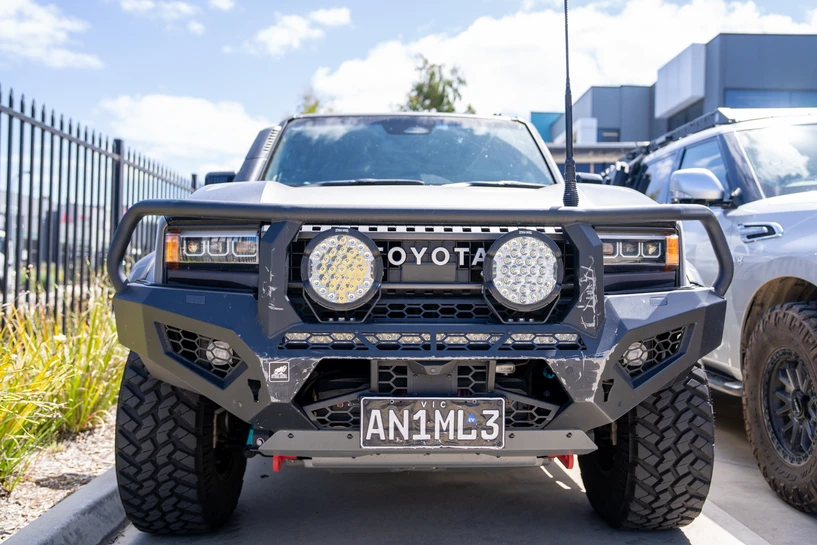
Let me start by saying that we're not 100% perfect, and our production lines are run by humans who can, and sometimes do, make mistakes. However, we set up processes to eliminate or at least minimise the faults. That being said, on the rare occasion a failure can happen, and for that, we offer a warranty. Okay, disclaimer done — let's get into it.
Offroad Animal applies a treatment to our products, especially bull bars, to offer customers some of the best corrosion protection in the business. Before I get into what we do, let me explain what just about every other company does, and then show you why ours is better.
Option A — what most cheap companies do (not Offroad Animal)
1. Fabricate bull bar
2. Orbital sand the outside of the bull bar
3. Powder coat the bare steel
4. Package bar for transit
This is pretty much the worst you can do or should I say bare minimum, as all the edges of the steel still have laser scale on them that flakes off pretty easily, and when the powder adheres to the scale, it comes off just as easily. If you're getting a super cheap bull bar, it's likely only had this sort of treatment. Basically, your bull bar is likely to rust in the near future and/or look pretty dodgy not long after fitment. You get what you pay for.
Option B — what better companies do (still not Offroad Animal)
1. Fabricate bull bar
2. Sandblast or shot blast the full bull bar
3. Zinc prime (powder coat a zinc-rich base primer)
4. Powder coat over the primer
5. Package bar for transit
Now, this is a lot better than Option A, but it's not the best. The sand/shot blasting does a great job of removing all the scale, leaving a great surface for the primer to adhere to, and then the regular top powder coat goes on top of that. You should get many years of good corrosion resistance with this set-up, and it's not super expensive to do, as after blasting you're basically just powder coating the bar twice.
So what's wrong with it? Well, if your bar takes a hit or rubs against something hard enough to take the powder coat off, that's exactly what will happen. Even with two layers of powder, it just comes off — and then your bar will start to rust, because the steel is exposed to the elements. Good, but not great.
So what is the best option? Well, that would be Option C, which is what Offroad Animal uses.
Option C — the best option (this is what Offroad Animal does)
1. Fabricate bull bar
2. Shot blast / sand blast bull bar
3. Zinc plate (or E-coat) the bull bar (more on what's done here soon) We zinc-plate
4. Powder coat the bull bar over the zinc plating
5. Pack for transit
Why is this best? Well, if the powder gets removed during a hit or a scrape on a tree or other off road obsitcle, the steel shouldn't start to rust, because the zinc plating is still there as a barrier against the elements. Think of it like one of the bolts you use — it's the same coating. Ready for the elements.
Now, to be fair, if you hit something hard enough to take the zinc off and damage the steel, you can get rust — but zinc holds on pretty well and much better than powder when taking a hit. This should give you the best possible protection from a rusty bull bar. Is it 100%? No, but nothing really is for steel. It's the best we have for bull bars. What is the down side of this process. Cost. It adds more cost, but if you're paying for a premium bull bar you want the best protection. At the end of the day you get what you pay for.
So what's involved in the zinc plating?
Here's the process:
1. Inspection
2. Acid degreasing
3. Water rinse
4. Surface cleaning
5. Water rinse
6. Zinc plate dip
7. Water rinse
8. Passivation
9. Water rinse
10. Air blow drying
11. Inspection
12. Transit to powder coat
This process allows us to achieve over 1,000 hours of salt spray testing, which is bloody good. Option A usually comes in at about 100 hours, and Option B at about 600 on average.
Here is a quick view of our powder coating line in our Australian manufacturing plate
Lastly, I'd like to point out that this is about rust protection, not powder coat durability. Our powder coat is much the same as any powder coat that's done properly — the product is cleaned properly, heated to the correct temperature for the correct amount of time (referred to as baked), and then cooled properly before packing. Yes, bull bars are heavy, and moving them around with people, forklifts and trucks can sometimes result in scratched or dented bars. For that, we have our warranty.
That my friends is why Offroad Animal bars are just better. Check out this video showing how bloody good they are. This Prado bull bar pushed a 79 series through a few flooded sections of desert and even 18 months on is showing almost no rust.